

AI Contextual Governance for Business Evolution and Adoption (2026 Guide)
AI contextual governance helps enterprises align AI with compliance, security, and business goals using real-time, context-aware controls.


Introduction
As organizations rapidly integrate AI into their core operations, traditional static governance models are struggling to keep up. The result? Increased compliance risks, over-restriction of valuable AI use cases, and slower business innovation.
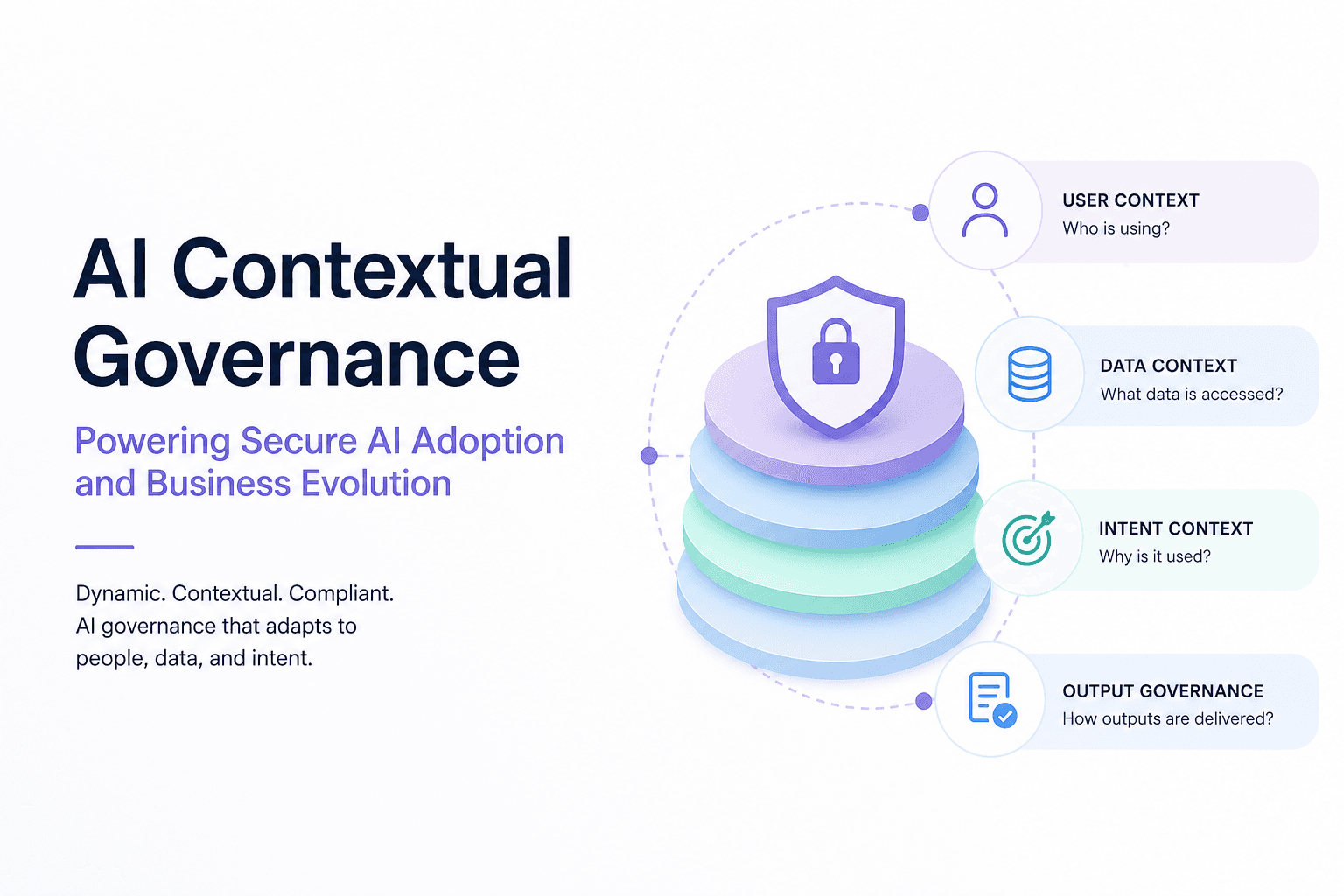
AI Contextual Governance has emerged as the solution. Unlike rigid rule-based systems, contextual governance dynamically adapts decisions based on who is using the AI, what data is involved, the intent behind the request, and the potential impact of the output.
In this guide, we present a practical 4-Layer AI Contextual Governance Framework designed specifically for enterprises scaling AI in 2026. This framework helps organizations move from reactive risk management to intelligent, real-time governance, enabling faster, safer, and more scalable AI adoption without compromising control or compliance.
Businesses that implement contextual governance are seeing higher AI utilization rates, fewer security incidents, and significantly smoother enterprise-wide rollout.
AI Contextual Governance in Business Evolution: A Real-World Example
A mid-sized SaaS company with 180 employees recently accelerated its AI adoption across sales, finance, and customer support. In the beginning, they used a traditional static governance model that applied the same strict rules to every user and use case. This approach created significant friction, sales teams couldn’t access timely customer insights, finance users faced unnecessary delays, and support agents were overly restricted in their responses.
After implementing a contextual governance framework, the company shifted to dynamic, context-aware policies. The system now evaluates each request based on the user’s role, data sensitivity, intent, and risk level in real time.
Results after implementation:
Sales teams received intelligent customer summaries and opportunity insights while automatically blocking access to sensitive payment data.
Finance users could analyze forecasts and trends with appropriate guardrails.
Customer support agents generated helpful, compliant responses without risking data leaks.
Within just three months, the outcomes were clear:
42% increase in daily AI tool adoption across teams
30% faster decision-making cycles
68% reduction in governance and compliance incidents
Higher employee satisfaction with AI tools
This example demonstrates how moving from rigid, one-size-fits-all governance to contextual governance enables organizations to scale AI safely and drive real business evolution.
What is AI Contextual Governance?
AI Contextual Governance is a modern, intelligent approach to AI oversight that applies dynamic, context-aware rules instead of rigid, one-size-fits-all policies.
It evaluates each AI interaction in real time based on multiple contextual factors — such as:
User role and permissions
Data sensitivity and classification
Intent behind the request
Business context and potential impact
This allows organizations to maintain strong control and compliance while still enabling flexible, high-value AI usage.
Traditional Governance vs AI Contextual Governance
Aspect | Traditional (Static) Governance | AI Contextual Governance |
|---|---|---|
Rule Application | Fixed rules for all users and cases | Dynamic rules based on real-time context |
Flexibility | Low – often overly restrictive | High – adapts to specific situations |
Decision Speed | Slow (manual reviews common) | Real-time |
Risk Management | Reactive | Proactive and precise |
AI Adoption Impact | Slows down innovation | Accelerates safe adoption |
In simple terms: Traditional governance is like putting the same speed limit on every road in a city. Contextual governance is like smart traffic signals that adjust limits based on weather, traffic density, vehicle type, and time of day.
This dynamic capability makes contextual governance essential for enterprises that want to scale AI responsibly across departments without compromising security, compliance, or productivity.
Why Traditional AI Governance Limits Business Evolution and Adoption
Traditional AI governance relies on fixed rules and predefined controls, which do not align with the dynamic nature of AI systems. These systems generate outputs based on changing inputs, making static governance ineffective in managing real-time decisions.
This creates limitations in how organizations scale AI across functions.
Another challenge is the lack of contextual awareness. Traditional governance treats all users and use cases similarly, which results in either over-restriction or excessive access.
This imbalance reduces both usability and security.
Operational inefficiency is also a concern. Manual approvals and rigid workflows slow down decision-making processes and reduce productivity.
This directly impacts the speed of AI adoption within organizations.
Additionally, traditional governance is reactive. Issues are addressed only after they occur, rather than being prevented proactively.
This increases risk exposure and reduces trust in AI systems.
The 4-Layer AI Contextual Governance Framework
To effectively implement AI contextual governance, organizations need a structured model that aligns governance with real-world usage. The 4-layer framework provides a clear approach to managing AI systems dynamically.
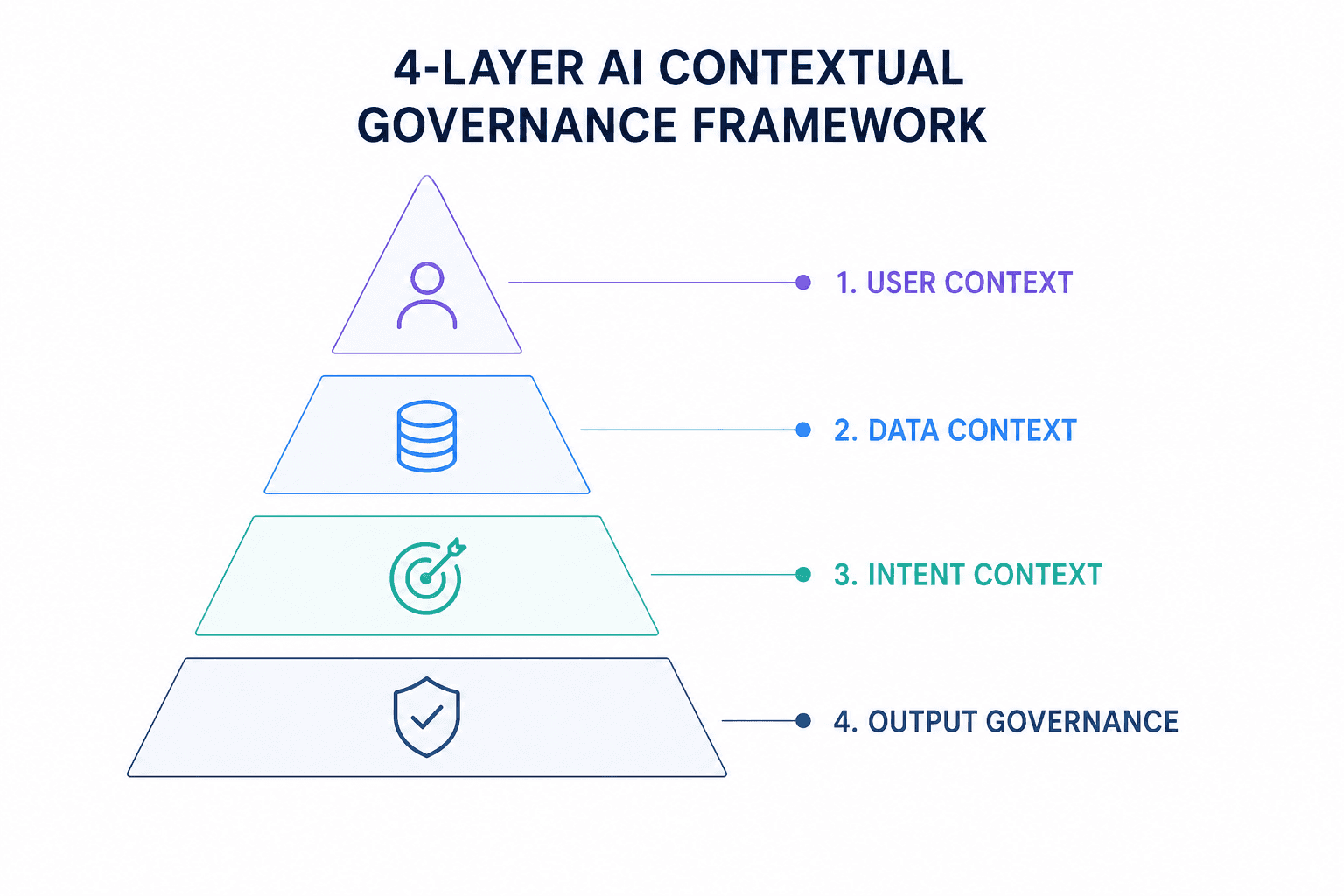
Layer 1: User Context
This foundational layer identifies who is interacting with the AI system. It goes beyond simple username checks and evaluates:
Role and seniority level
Department and team
Current project or business unit
Access privileges and historical behavior
Example: A Chief Marketing Officer can receive high-level competitive analysis and strategic recommendations, while a junior analyst receives only aggregated, anonymized data views.
Why it matters: Governance becomes proportional to responsibility. This layer prevents over-privileged access and reduces insider risk while empowering employees with appropriate AI capabilities.
Layer 2: Data Context
This layer assesses what data is being accessed or processed. It dynamically classifies and tags data based on sensitivity and regulatory requirements.
Key elements include:
Data classification (Public, Internal, Confidential, Highly Restricted)
Data type (structured vs unstructured)
Regulatory obligations (GDPR, HIPAA, SOC 2, etc.)
Data freshness and source credibility
Example: When a user asks for customer insights, the system automatically restricts exposure of personally identifiable information (PII) for non-compliance roles while allowing aggregated behavioral trends.
Why it matters: It minimizes data breach risks and ensures compliance without blocking legitimate business use cases.
Layer 3: Intent Context
This layer understands why the AI is being used — the purpose and objective behind the request.
It analyzes:
Query intent (exploratory, analytical, operational, creative, decision-making)
Expected outcome
Urgency and business impact
Potential risk level
Example: An exploratory query like “Show me general market trends” can receive broader access, while a high-stakes query like “Generate a financial forecast for investor presentation” triggers stricter validation and human review.
Why it matters: Intent-based governance allows flexibility for innovation while applying tighter controls where mistakes can be costly.
Layer 4: Output Governance
The final layer controls what the AI actually delivers — the quality, format, and safety of the output.
This includes:
Content filtering and redaction
Accuracy and hallucination checks
Compliance and tone validation
Formatting according to user role and channel
Watermarking or audit logging when needed
Example: A support agent receives a helpful, fully compliant response template, while a legal team member gets detailed analysis with all sources cited and risk flags highlighted.
Why it matters: Even if the first three layers approve access, the output itself must be safe, accurate, and appropriate for the context.
Why This 4-Layer Framework Works
By combining these four layers, organizations move from static, one-size-fits-all governance to adaptive, real-time control. This results in:
Higher AI adoption rates
Lower compliance and security risks
Faster decision-making
Better trust across departments
This framework is flexible enough to work with most enterprise AI tools, including custom LLMs, copilots, and agentic systems.
Static vs AI Contextual Governance in Business Adoption
Factor | Static Governance | AI Contextual Governance |
|---|---|---|
Policy Design | Fixed and rule-based, difficult to adapt | Dynamic and context-aware, adjusts in real time |
User Access | Same access for all roles | Role-based access aligned with responsibilities |
Limited classification and control | Advanced data sensitivity and contextual filtering | |
Decision Speed | Slower due to approvals and restrictions | Faster with automated and adaptive controls |
Risk Management | Reactive and incident-based | Proactive with real-time monitoring and prevention |
Business Alignment | Weak alignment with workflows | Strong alignment with operational needs |
This comparison shows why AI contextual governance is essential for modern business adoption strategies.
Role of AI Contextual Governance in Business Evolution
1. Enables scalable AI adoption
AI contextual governance allows organizations to expand AI usage across teams while maintaining consistent control. This ensures growth without increasing operational or compliance risks.
2. Improves decision intelligence
Context-aware AI systems provide insights tailored to user roles and business scenarios. This improves accuracy, reduces irrelevant outputs, and supports better decision-making.
3. Enhances operational efficiency
Dynamic governance reduces dependency on manual approvals and rigid workflows. Teams can access insights faster, improving productivity and overall performance.
4. Strengthens compliance and trust
Real-time enforcement of governance policies ensures adherence to regulations. This builds trust among stakeholders and improves the reliability of AI systems.
Real-World AI Contextual Governance Examples
Microsoft Copilot enterprise governance
Microsoft applies role-based access and contextual data controls within Copilot. This ensures enterprise users can safely interact with AI while maintaining compliance and data protection across organizational workflows.
Google Cloud AI governance policies
Google Cloud enables context-aware policy enforcement for AI workloads. It allows organizations to define governance rules based on data sensitivity and usage context, especially in regulated industries.
IBM AI governance framework
IBM integrates contextual risk monitoring into its AI governance model. This helps organizations manage bias, ensure transparency, and maintain compliance across AI-driven processes.
OpenAI usage safeguards
OpenAI implements intent-based safeguards that guide responsible AI usage. These controls help reduce misuse while maintaining flexibility for different applications and user needs.
How to Implement AI Contextual Governance
To implement AI contextual governance, organizations must first define clear context parameters such as user roles, data types, and intent categories. These elements form the foundation for dynamic governance.
Next, governance policies should be designed to adapt based on these contexts. This includes role-based access, data filtering, and output control mechanisms.
Organizations should then integrate governance into AI workflows using monitoring tools and automation systems. Continuous evaluation and feedback loops are essential to refine policies and ensure alignment with evolving business needs.
Challenges in AI Contextual Governance Adoption
AI contextual governance introduces complexity in defining and managing multiple context layers. Organizations must ensure consistency in how user roles, data sensitivity, and intent are interpreted across systems.
Balancing flexibility and control is another challenge. Excessive restrictions can limit AI usability, while insufficient governance increases risk exposure. Achieving the right balance requires continuous monitoring and adjustment.
Data privacy and compliance remain critical concerns. Context-aware systems rely on sensitive data, which must be handled securely and in alignment with regulations.
Future of AI Contextual Governance in Business
AI contextual governance will evolve toward real-time, intelligent systems that automatically adjust policies based on usage patterns. This will reduce manual intervention and improve scalability.
The rise of AI agents will further increase the need for governance. Systems will not only generate outputs but also perform actions, requiring deeper oversight and control mechanisms.
Organizations are also moving toward unified governance platforms that integrate data, AI, and policy management. This shift will define the next phase of AI adoption.
Conclusion
AI contextual governance is becoming a foundational element in business evolution and adoption strategies. As AI systems grow more complex, static governance models are no longer sufficient to manage risks and ensure effective usage.
By implementing AI contextual governance, organizations can align AI systems with real-world business needs. This enables faster adoption, better decision-making, and stronger compliance.
In the long term, businesses that adopt contextual governance will be better positioned to scale AI responsibly and maintain a competitive advantage in an increasingly AI-driven landscape.