

What Is Business Activity Monitoring? (BAM Explained with Examples & Benefits)
Learn what business activity monitoring (BAM) is, how it works, key benefits, and real-time use cases to improve business performance and decision-making.

Introduction: Why are decisions still based on outdated reports?
A campaign underperforms. Sales suddenly drop. A system slows down.
But the report comes hours or even days later. By the time teams notice the issue, the opportunity to act early is already lost.
This is still a common problem across many businesses. Decisions are often based on historical reports instead of real-time data. While traditional reporting helps understand past performance, it does not help when immediate action is required.
In today’s fast-moving environment, businesses cannot afford delays. Customer behavior changes quickly, markets shift rapidly, and operations need constant monitoring.
This is where business activity monitoring (BAM) becomes important.
A business activity monitor allows companies to track their operations, performance metrics, and key business events in real time. Instead of reacting late, teams can identify problems early and take action immediately.
For different teams, the value is clear:
Business leaders get real-time visibility into performance and can make faster strategic decisions
Data teams and analysts reduce manual reporting and focus more on insights rather than data collection
In this guide, you will learn:
What business activity monitoring is
How it works in real-world systems
Key benefits and features
Practical use cases across industries
How to choose the right tools for your business
What is Business Activity Monitoring (BAM)?
Business Activity Monitoring (BAM) is a system that tracks business processes and KPIs in real time, giving teams instant visibility into performance so they can quickly identify problems and take action.
Unlike traditional reporting systems that rely on periodic updates, BAM focuses on continuous monitoring and instant feedback, helping businesses move from reactive decisions to proactive execution.
At a deeper level, BAM works by connecting multiple systems and continuously analyzing data as it flows through the organization. It can:
Monitor business processes as they happen across different systems
Track KPIs continuously instead of relying on delayed reports
Detect events, anomalies, or performance drops in real time
Trigger alerts and automated actions based on predefined conditions
Through this approach, teams gain clearer visibility into operations, while data is transformed into actionable insights without delays.
In simple terms, BAM helps answer critical questions like:
Are we hitting our targets right now?
Is any part of the business underperforming?
Are there risks that need immediate attention?
By using real-time monitoring, businesses can respond faster, improve efficiency, and reduce the chances of missing important signals hidden in their data.
It is also closely related to:
Business monitoring systems
Business health monitoring
Real-time analytics and observability
Meanwhile, research and enterprise use cases show that organizations adopting real-time monitoring can significantly reduce response time to incidents and improve operational efficiency. According to industry insights shared by IBM, businesses that rely on real-time data can detect issues earlier, respond faster, and improve overall performance by making decisions based on live insights rather than delayed reports. This shift helps teams stay aligned, act quickly, and continuously optimize outcomes.
How Business Activity Monitoring Works
Business activity monitoring works by connecting multiple systems and continuously analyzing data to deliver real-time insights. It is not just a single tool, but a structured process that turns raw data into immediate, actionable information.
At a high level, BAM collects data, processes it instantly, evaluates performance, and delivers insights through dashboards and alerts to help teams take quick action.
1. Data collection from multiple sources
BAM starts by gathering data from across the business. This includes systems such as CRM, ERP, marketing tools, and external APIs.
Sales data from CRM platforms
Financial and operational data from ERP systems
Campaign and user data from marketing tools
Additional inputs from APIs and third-party platforms
By bringing all this data together, BAM creates a unified view of business activity. This helps teams avoid working in silos and ensures decisions are based on complete information.
2. Real-time data processing
Once data is collected, it is processed immediately using stream processing.
Data is analyzed as soon as it is generated
There is no delay from batch processing
Changes and trends are visible instantly
This real-time processing allows businesses to move from delayed reporting to continuous monitoring. It also helps teams react faster to any changes in performance.
3. KPI evaluation and rule-based tracking
After processing, the system evaluates data against predefined KPIs and rules.
Metrics are continuously compared with targets
Thresholds are set to identify performance issues
Rules detect unusual patterns or anomalies
For example:
A drop in revenue can be flagged instantly
A sudden increase in system response time can trigger alerts
This step ensures that important signals are not missed and that teams are always aware of performance changes.
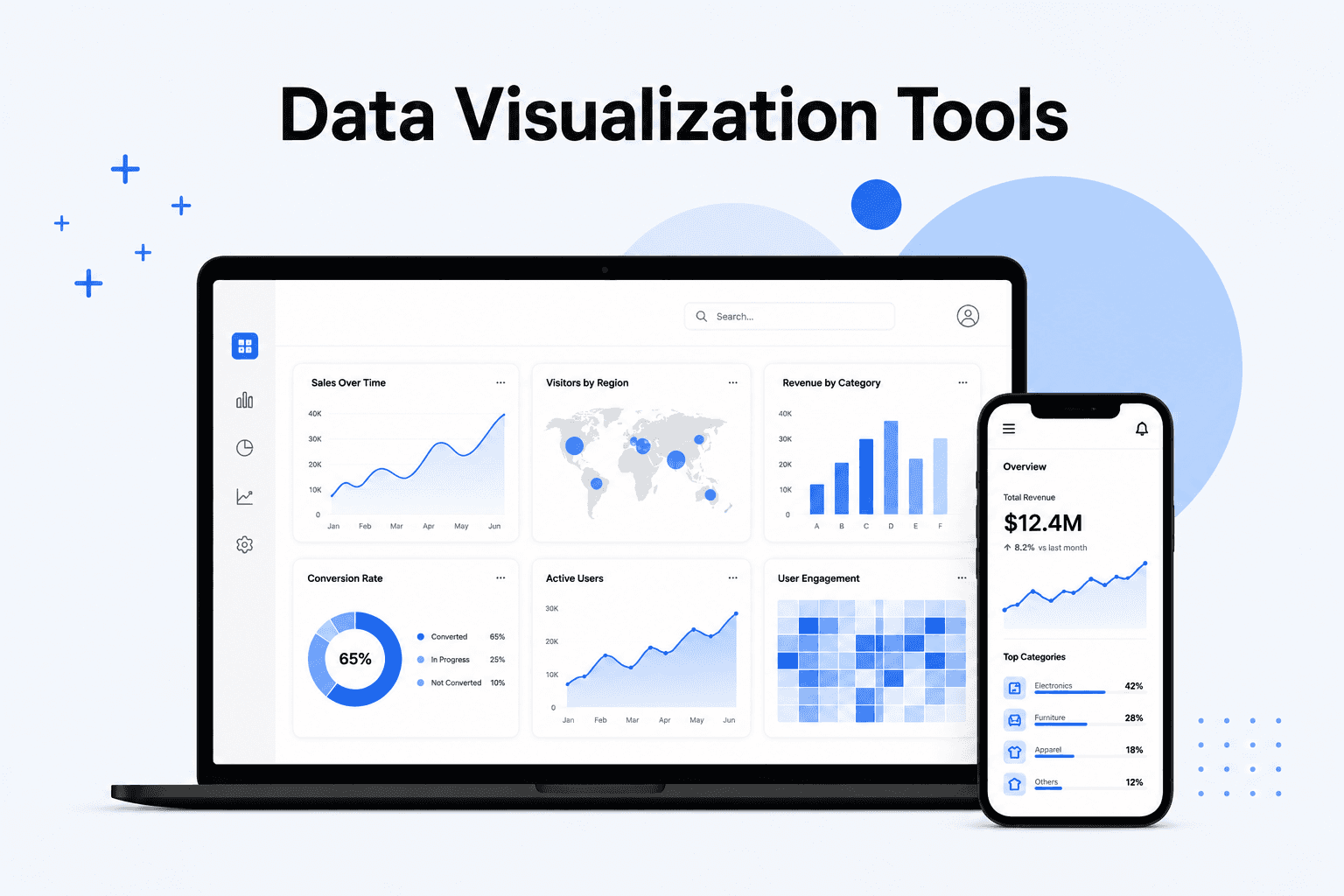
4. Data visualization through dashboards
Processed data is then presented through dashboards for easy understanding.
Visual formats like charts and graphs simplify complex data
Teams can quickly assess performance without deep analysis
Custom dashboards allow different departments to focus on relevant KPIs
By using clear visualizations, BAM makes data more accessible and useful for decision-making.
5. Alerts, notifications, and automated actions
The final step is turning insights into action.
Alerts are triggered when conditions or thresholds are met
Notifications are sent through channels like email or Slack
Automated workflows can take predefined actions without manual input
This ensures that issues are addressed immediately instead of waiting for manual review.
Quick summary
Business activity monitoring works by collecting data from multiple systems, processing it in real time, evaluating it against KPIs, and delivering insights through dashboards and alerts. This allows teams to monitor performance continuously and take immediate action when needed.
Why Business Activity Monitoring Matters
Business activity monitoring directly improves how businesses operate, make decisions, and compete. Here’s a clear breakdown of its impact:
Area | What It Means | Key Benefits | Example |
|---|---|---|---|
Real-time decision making | Decisions are based on live data instead of delayed reports | Faster response to changes, early opportunity capture, quicker issue resolution | A sudden drop in conversion rate is detected and fixed immediately |
Operational efficiency | Continuous visibility into processes helps identify inefficiencies | Faster detection of bottlenecks, better resource allocation, ongoing process optimization | A slow internal workflow is identified and optimized to improve output |
Proactive risk detection | Issues are identified before they become serious problems | Early anomaly detection, reduced downtime, lower financial risk | A supply chain delay is flagged before it affects customer delivery |
KPI visibility and alignment | Teams track performance metrics in real time across the organization | Better transparency, aligned goals, continuous performance tracking | Sales and marketing teams monitor the same live KPIs to stay aligned |
Competitive advantage | Faster insights lead to faster actions compared to competitors | Improved customer experience, quicker decision cycles, stronger operations | A company reacts instantly to market changes while competitors lag behind |
Key Features of Business Activity Monitoring Software
Business activity monitoring software provides real-time visibility into business operations by collecting, processing, and visualizing data from multiple systems. It helps teams track KPIs, detect issues early, and take immediate action based on live insights.
To understand its real value, here are the core features that define modern BAM tools:
Real-time dashboards and data visualization
Real-time dashboards are the foundation of any BAM system. They turn complex data into clear, actionable insights.
Provide a centralized view of all business metrics in one place
Display live updates without delays or refresh cycles
Use charts, graphs, and visual indicators to simplify decision-making
Allow teams to monitor performance instantly without deep analysis
This helps teams quickly understand what is happening across the business at any moment.
Advanced KPI tracking and performance monitoring
BAM tools are built around continuous KPI tracking, which ensures that performance is always measurable.
Track key performance indicators in real time
Compare actual performance against targets and benchmarks
Customize KPIs based on business goals and departments
Identify performance gaps and improvement areas instantly
By using KPI tracking, teams can focus on what truly impacts growth and efficiency.
Intelligent alerts and notification systems
One of the most critical features of BAM is its ability to notify teams instantly when something changes.
Trigger alerts based on predefined thresholds and conditions
Detect anomalies, risks, or SLA breaches automatically
Send notifications through email, Slack, or other channels
Reduce the need for constant manual monitoring
This ensures that issues are identified and addressed before they escalate.
Data integration and aggregation from multiple sources
BAM systems bring together data from different tools to create a unified view of operations.
Integrate with CRM, ERP, marketing platforms, and APIs
Combine structured and unstructured data sources
Eliminate data silos across departments
Provide a single source of truth for decision-making
This integration is essential for accurate and complete business insights.
End-to-end process tracking
Modern BAM tools go beyond metrics and allow full visibility into business processes.
Track workflows and transactions from start to finish
Monitor multi-step processes across systems
Identify delays or inefficiencies in specific stages
Ensure smooth execution of operations
This helps organizations maintain control over complex processes.
Scalability and high-performance processing
As businesses grow, their data needs increase. BAM tools are designed to handle this scale.
Process large volumes of real-time data efficiently
Maintain performance even with increasing workloads
Support enterprise-level operations and complexity
Adapt to growing business requirements
This ensures long-term usability without performance issues.
Automation and workflow triggers
Automation is what turns insights into action.
Trigger automated workflows based on real-time conditions
Reduce manual intervention in repetitive tasks
Improve response time to business events
Increase overall operational efficiency
By using automation, teams can act faster and focus on higher-value tasks.
Analysis, reporting, and continuous improvement
While BAM focuses on real-time monitoring, it also supports deeper analysis.
Analyze trends and patterns over time
Compare historical and real-time data
Generate reports for performance evaluation
Support data-driven decision-making
This helps businesses not only react in real time but also improve long-term performance.
Role-based access and data control
Security and usability are important in any business system.
Provide role-based access to different users
Customize dashboards based on team needs
Ensure sensitive data is only accessible to authorized users
Improve collaboration while maintaining control
Quick summary
Business activity monitoring software includes features like real-time dashboards, KPI tracking, automated alerts, data integration, process tracking, and workflow automation. These capabilities help organizations monitor operations continuously, detect issues early, and make faster, data-driven decisions.
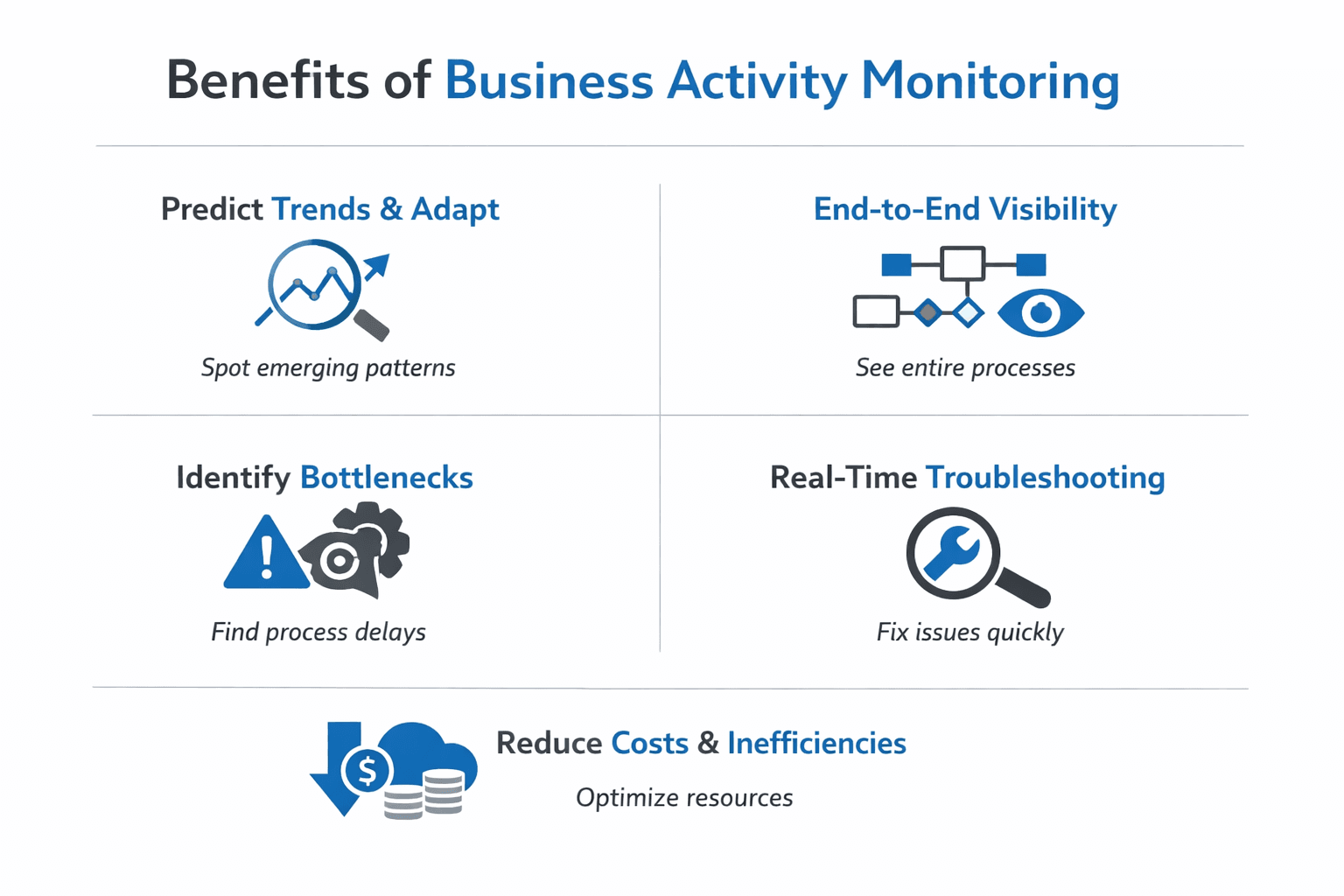
What are the benefits of business activity monitoring?
Using business activity monitoring tools, organizations can gain real-time visibility into operations, identify inefficiencies early, and continuously improve business processes through data-driven insights.
Business Activity Monitoring vs Business Intelligence
Understanding the difference between BAM and business intelligence is important for choosing the right approach for your use case. While both deal with data, they serve very different purposes.
Core Comparison
Feature | Business Activity Monitoring (BAM) | Business Intelligence (BI) |
|---|---|---|
Time focus | Real-time (current state) | Historical + current trends |
Scope | Specific processes and transactions | Organization-wide data analysis |
Primary users | Operational managers, process owners | Executives, analysts, business users |
Focus area | Process flow and live operations | Data analysis and reporting |
Purpose | Immediate issue detection and action | Strategic insights and planning |
Data level | Granular, detailed | Aggregated, summarized |
Output | Alerts, live dashboards | Reports, visualizations, dashboards |
Key Differences Explained
Immediate action vs long-term insight
BAM helps fix issues as they happen, such as a failed transaction or system delay
BI helps understand patterns over time, such as why failures are increasing
Process vs data focus
BAM monitors how processes are flowing in real time
BI analyzes data to identify trends and performance patterns
Granularity of insights
BAM provides detailed, low-level visibility into operations
BI provides high-level summaries for decision-making
When to Use BAM vs BI
Use Case | Best Approach |
|---|---|
Monitoring live operations or transactions | BAM |
Ensuring SLAs are met in real time | BAM |
Tracking supply chain or system performance live | BAM |
Monthly or quarterly business reporting | BI |
Identifying trends and growth patterns | BI |
Strategic planning and forecasting | BI |
Quick takeaway
Use BAM when you need to know what is happening right now and take immediate action
Use BI when you want to understand past performance and plan for the future
In most modern businesses, both are used together. BAM handles real-time operations, while BI supports long-term strategy.
Key differences explained
Timing: BAM focuses on what is happening now, while business intelligence focuses on past data
Usage: BAM is used for daily operations, while BI is used for long-term strategy
Actionability: BAM enables immediate action, while BI supports decision-making through analysis
How they work together
BAM and BI should not be seen as separate systems.
BAM provides real-time insights
BI provides deeper analysis
Together, they give a complete view of business performance.
Top Use Cases of Business Activity Monitoring
Business activity monitoring is widely used across industries, but some use cases stand out because of their direct impact on revenue and operations.
E-commerce: Real-time order and checkout monitoring
Track live transactions and checkout flows
Detect failed payments or drop-offs instantly
Monitor inventory and order fulfillment in real time
Example: If checkout failures suddenly increase, the issue can be identified and fixed immediately, preventing revenue loss.
According to industry insights, even a 1-second delay in page load can reduce conversions by up to 7%, making real-time monitoring critical for e-commerce performance.
IT and SaaS: Application performance and uptime monitoring
Monitor system uptime and response time continuously
Detect outages, latency spikes, or performance issues
Ensure service reliability and meet SLAs
Example: A sudden spike in server response time is detected in real time, allowing teams to resolve it before users are affected.
Research shows that the average cost of IT downtime can range from $5,000 to $9,000 per minute, highlighting the importance of real-time monitoring.
These use cases show how business activity monitoring helps teams act faster, reduce losses, and maintain consistent performance in real-world scenarios.
Real-Time Monitoring and KPIs: The Core of BAM
At the core of business activity monitoring are real-time monitoring and KPIs, which help teams focus on what matters and act quickly.
Real-time monitoring
Tracks business data continuously across systems
Provides instant updates without delays
Helps teams respond quickly to changes or issues
Supports faster and more accurate decision-making
KPIs (Key Performance Indicators)
Define the most important business metrics
Help measure performance against goals
Focus attention on high-impact areas
Common KPIs:
Revenue and profit margins
Conversion rates
Customer acquisition cost
Operational efficiency
System uptime and response time
Why KPIs are critical
Filter out unnecessary data and noise
Keep teams aligned with business goals
Enable better, data-driven decisions
Without clear KPIs, BAM can become overwhelming. With the right KPIs, it becomes a focused and powerful decision-making tool.
Know More About KPI.
How to Choose the Right Business Activity Monitoring Tool ?
Integration capability: Connects easily with existing systems, creating unified data flow and eliminating data silos
Ease of use: Simple, intuitive dashboards that reduce training time and improve team adoption across departments
Customization: Supports custom KPIs and dashboards tailored to specific business goals and operational needs
Data latency and performance: Provides near real-time data processing for faster insights and accurate, timely decision-making
Cost and scalability: Fits budget requirements and scales efficiently as business data and operational complexity increase.
Challenges and Limitations of BAM
Data overload: Excessive data can overwhelm teams, making it harder to focus on meaningful insights
Integration complexity: Integrating multiple systems can be complex, requiring time, resources, and technical expertise
Cost considerations: Advanced BAM tools and implementation can be costly, especially for growing or smaller businesses
Data quality issues: Inaccurate or incomplete data leads to poor insights and unreliable decision-making.
Future of Business Activity Monitoring
Business activity monitoring is moving beyond basic dashboards toward intelligent, self-improving systems that not only track data but also guide decisions in real time.
AI-powered decision intelligence
Detects patterns, anomalies, and opportunities automatically using machine learning
Reduces manual analysis and improves speed of insights
Predictive and proactive monitoring
Forecasts risks, demand, and performance trends before they happen
Helps teams act early instead of reacting after issues occur
Autonomous workflows and automation
Triggers actions automatically based on real-time conditions
Minimizes human intervention and reduces response time
Context-aware insights
Combines data from multiple sources to provide deeper, more relevant insights
Helps teams understand not just what is happening, but why
Human + AI collaboration
AI delivers insights while humans make strategic decisions
Improves accuracy, efficiency, and overall business outcomes
Business activity monitoring is evolving into a smarter system that not only tracks performance but actively improves it.
Frequently Asked Questions (FAQs)
What is business activity monitoring in simple terms?
Business activity monitoring is a real-time monitoring system that tracks business processes and KPIs to provide instant visibility into operations. It helps organizations detect issues early, improve performance, and make faster decisions using live data instead of relying on delayed reports.
What does a business activity monitor do?
A business activity monitor collects and analyzes real-time data from multiple systems to track performance, monitor KPIs, and trigger alerts. It helps teams identify problems instantly, automate responses, and maintain smooth operations across different business processes.
How does business activity monitoring work?
Business activity monitoring works by collecting data from systems like CRM and ERP, processing it in real time, and evaluating it against KPIs. It then displays insights through dashboards and sends alerts when performance changes or issues are detected.
What is the difference between BAM and business intelligence?
Business activity monitoring focuses on real-time data and immediate actions, while business intelligence analyzes historical data for trends and strategy. BAM helps with operational decisions, whereas business intelligence supports long-term planning and performance analysis.
What are the key features of business activity monitoring tools?
Business activity monitoring tools include real-time dashboards, KPI tracking, automated alerts, data integration, and workflow automation. These features help organizations monitor performance continuously, detect anomalies early, and make faster, data-driven decisions across business operations.
What are examples of business activity monitoring tools?
Examples of business activity monitoring tools include real-time dashboard platforms, analytics tools, and monitoring systems integrated with CRM, ERP, and cloud applications. These tools help track KPIs, monitor processes, and provide live insights into business performance.
What KPIs are used in business activity monitoring?
Common KPIs in business activity monitoring include revenue, conversion rate, customer acquisition cost, operational efficiency, and system uptime. These metrics help businesses measure performance in real time and ensure that operations align with business goals.
What are the benefits of business activity monitoring?
Business activity monitoring improves real-time decision-making, increases operational efficiency, and helps detect issues early. It provides continuous visibility into processes, enabling teams to respond quickly, reduce risks, and optimize performance using real-time insights from business data.
Is business activity monitoring suitable for small businesses?
Yes, business activity monitoring is suitable for small businesses because many tools are scalable and cost-effective. It helps small teams track KPIs, monitor performance in real time, and make better decisions without relying on complex reporting systems.
Why is real-time monitoring important in business?
Real-time monitoring is important because it allows businesses to track performance instantly, detect issues early, and respond quickly. It reduces delays in decision-making and helps organizations stay competitive by using up-to-date data instead of relying on outdated reports.
Conclusion
Business activity monitoring helps businesses move from delayed reporting to real-time decision-making. Instead of reacting to problems after they happen, teams can track performance continuously and act at the right moment.
It enables:
Real-time visibility into operations across systems
Better tracking and alignment of KPIs
Faster response to issues, risks, and opportunities
In today’s fast-changing environment, relying only on historical data is not enough. Businesses need live insights to stay competitive, improve efficiency, and make smarter decisions.
If you are still depending on static reports, this is the right time to shift toward real-time monitoring. Start by identifying your key metrics, connect your data sources, and build a system that gives you instant visibility.
Want to see your business data in real time without complexity? Try Supaboard and turn your data into actionable dashboards in minutes.