

Is It Analyzing or Analysing?
Is it analyzing or analysing? Understand the meaning and spelling difference between US and UK English and when to use each.



Introduction
Is it analyzing or analysing? If you’ve ever been unsure which spelling to use, you’re not alone. This is one of the most commonly searched grammar questions, especially among writers, students, and professionals working across different regions.
The difference comes down to American vs British English spelling, but using the correct form matters for clarity, consistency, and professional communication. Whether you're writing blogs, emails, or reports, the spelling you choose can influence how your work is perceived.
In this guide, we’ll break down the difference between analyzing vs analysing, explain when to use each, and highlight common mistakes to avoid, so your writing stays accurate and consistent.
According to Merriam-Webster, “analyze” means to examine something carefully to understand it better. While the meaning stays the same, the spelling changes by region, which is where confusion often begins for global writers.
Does It Matter If You Use “Analyze” or “Analyse”?
At first glance, this might feel like a small detail. But in practice, it affects more than you think.
1. It shapes how your content feels to readers: People naturally trust what looks familiar. A US reader may pause at “analysing,” while a UK reader may notice “analyzing” as slightly off.
2. It impacts search visibility: Users search differently based on region. Some type “analyzing,” others type “analysing.” Covering both, correctly helps you capture global traffic.
3. It affects brand consistency: If your blog switches between US and UK spelling, it looks careless. Consistency makes your content feel more polished and credible.
4. It matters in professional settings: Many companies follow strict style guides (especially SaaS, tech, and marketing teams). Using the wrong spelling can break alignment across content
What Is the Difference Between Analyze vs Analyse?
The difference between “analyze” and “analyse” comes down to spelling conventions based on region. Both refer to examining something in detail to understand it better.
“Analyze” is used in American English, while “analyse” is standard in British English and countries like India, Australia, and the UK. The choice depends entirely on your audience and writing style, not on any change in meaning.
Factor | Analyze (American English) | Analyse (British English) |
|---|---|---|
Spelling Style | Uses “z” | Uses “s” |
Region | United States, Canada | UK, India, Australia, etc. |
Meaning | Same meaning | Same meaning |
Usage in Tech/Business | More common globally | Less common in global SaaS |
Formality | Standard | Standard |
The key takeaway: There is no difference in meaning, only in regional spelling.
When to Use “Analyze” vs “Analyse”
Here’s a simple way to decide which one to use
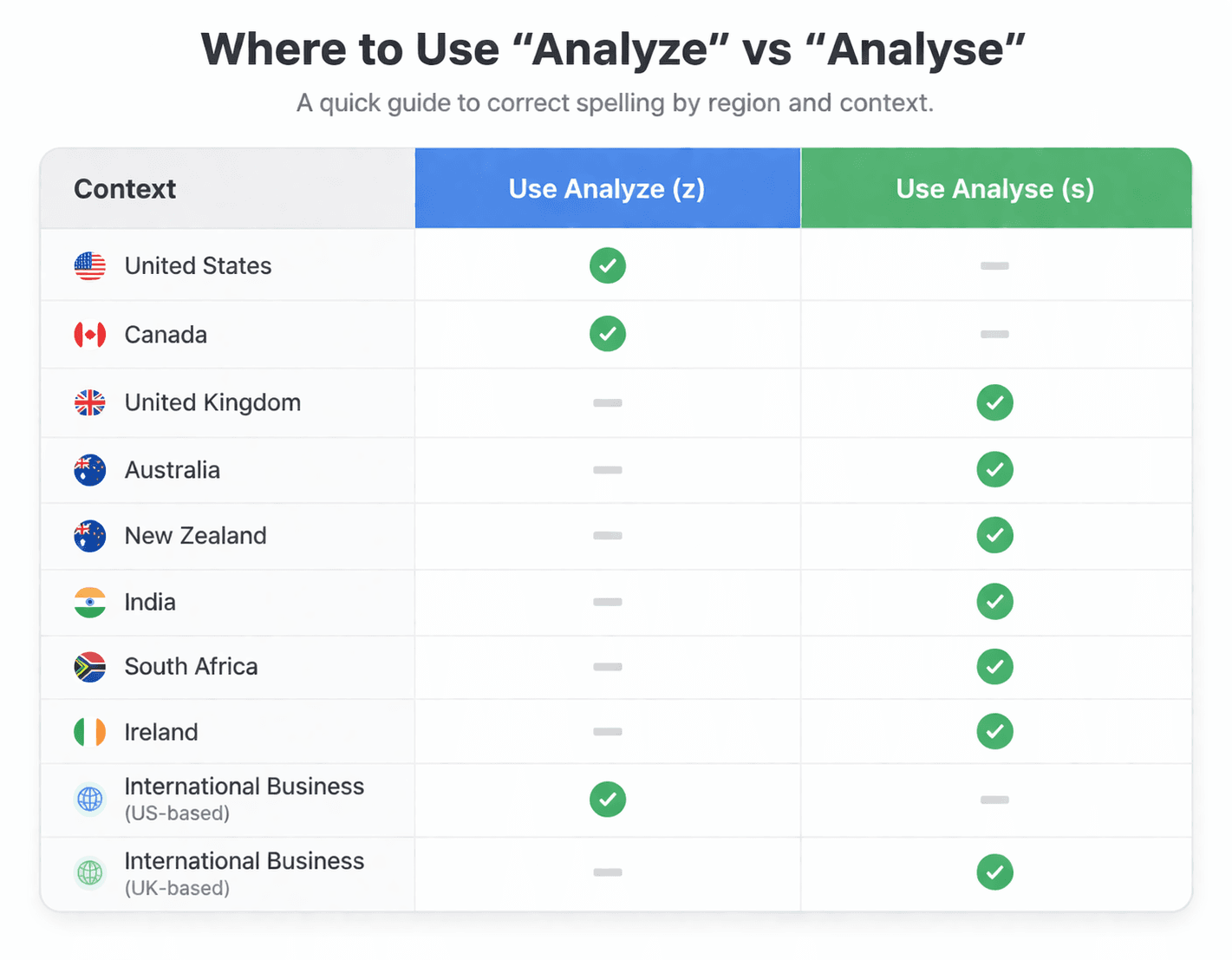
If your product, audience, or company is US-focused → go with analyze
If you’re writing for UK/Commonwealth → use analyse
Examples That Make It Clear
Sometimes the easiest way to understand is by seeing it in real use.
Using “analyzing” (US English):
We are analyzing customer behavior data to improve conversions.
The team is analyzing performance trends across campaigns.
Using “analysing” (UK English):
The team is analysing market trends for the upcoming quarter.
This report focuses on analysing financial performance.
Notice: only the spelling changes, the meaning stays the same.
This is one of the most common areas where people get confused — especially in search queries like “analysis vs analyses” or “analyze vs analysis meaning.”
All three words are related, but they serve completely different roles in a sentence. Understanding this difference helps you write more clearly and avoid basic grammar mistakes.
Key Differences at a Glance
Word | Part of Speech | Meaning | Example |
|---|---|---|---|
Analyze / Analyse | Verb (action) | To examine something in detail | We analyze customer data daily. |
Analysis | Noun (singular) | One detailed study or result | The analysis shows clear trends. |
Analyses | Noun (plural) | More than one study or evaluation | Multiple analyses were conducted. |
💡 Simple Way to Remember
Analyze / Analyse → action
Analysis → one result
Analyses → multiple results
Which One Should You Use for a Global Audience?
If your audience spans multiple regions (US, UK, and beyond), choosing between “analyzing vs analysing” comes down to consistency and context, not correctness.
A practical approach is to pick one spelling based on your primary audience and use it consistently across your website, blog, and product content. Mixing both can confuse readers and weaken your brand voice.
If you’re unsure, “analyzing” (American English) is more widely used in global tech, SaaS, and business content, making it a safer default for international audiences.
That said, if your audience is primarily from the UK, India, or other Commonwealth countries, “analysing” will feel more natural and familiar.
In simple terms, analyzing is the American English spelling, while analysing is the British English spelling. Both have the same meaning, and the right choice depends on your audience, region, and content strategy.
In real-world scenarios, especially when analyzing data in business intelligence tools, clarity in language becomes important, as teams across different regions rely on consistent terminology to understand insights correctly.
Frequently Asked Questions
Is “analyzing” the correct spelling?
Yes, “analyzing” is the correct spelling in American English. It’s commonly used in the United States and widely accepted in global tech, SaaS, and business content. If your audience is international or US-focused, “analyzing” is usually the safer and more familiar choice.
Is “analyse” wrong in the US?
No, “analyse” is not wrong, but it’s uncommon in American English. US readers may find it unusual or assume it’s a mistake. For US-based content, it’s better to use “analyze” to match expectations and maintain clarity.
Why do Americans use “z” instead of “s”?
American English uses “z” in words like “analyze” due to spelling reforms led by Noah Webster. His goal was to simplify and standardize English. British English retained the “s” form, which is why both “analyze” and “analyse” exist today.
Which spelling should I use for SEO?
For SEO, choose the spelling your audience is most likely to search. If your traffic is global, include both “analyzing vs analysing” naturally in your content. However, keep one primary version consistent to avoid confusion and improve content clarity.
Is “analyzing” more common than “analysing”?
Globally, “analyzing” is more common, especially in digital, tech, and business content. However, “analysing” is still widely used in the UK, India, and other Commonwealth countries. The best choice depends on your audience’s location.
Final Thoughts
Choosing between “analyzing vs analysing” isn’t about right or wrong, it’s about context, audience, and consistency.
Both spellings are correct and carry the same meaning. What truly matters is using the version your readers expect and sticking with it throughout your content. When your language aligns with your audience, your content becomes easier to read, more trustworthy, and more effective, both for users and search engines.
Turn your data into answers, not dashboards. With Supaboard, you can analyze your data instantly using simple questions, no SQL, no complexity. Try it with your own data and see the difference.