

Supaboard AI Review: Features, Use Cases & Product Hunt Launch Story
Explore Supaboard AI 3.0, an AI-native business intelligence platform that helps teams ask questions in plain English, build dashboards instantly, and get insights from data without SQL.

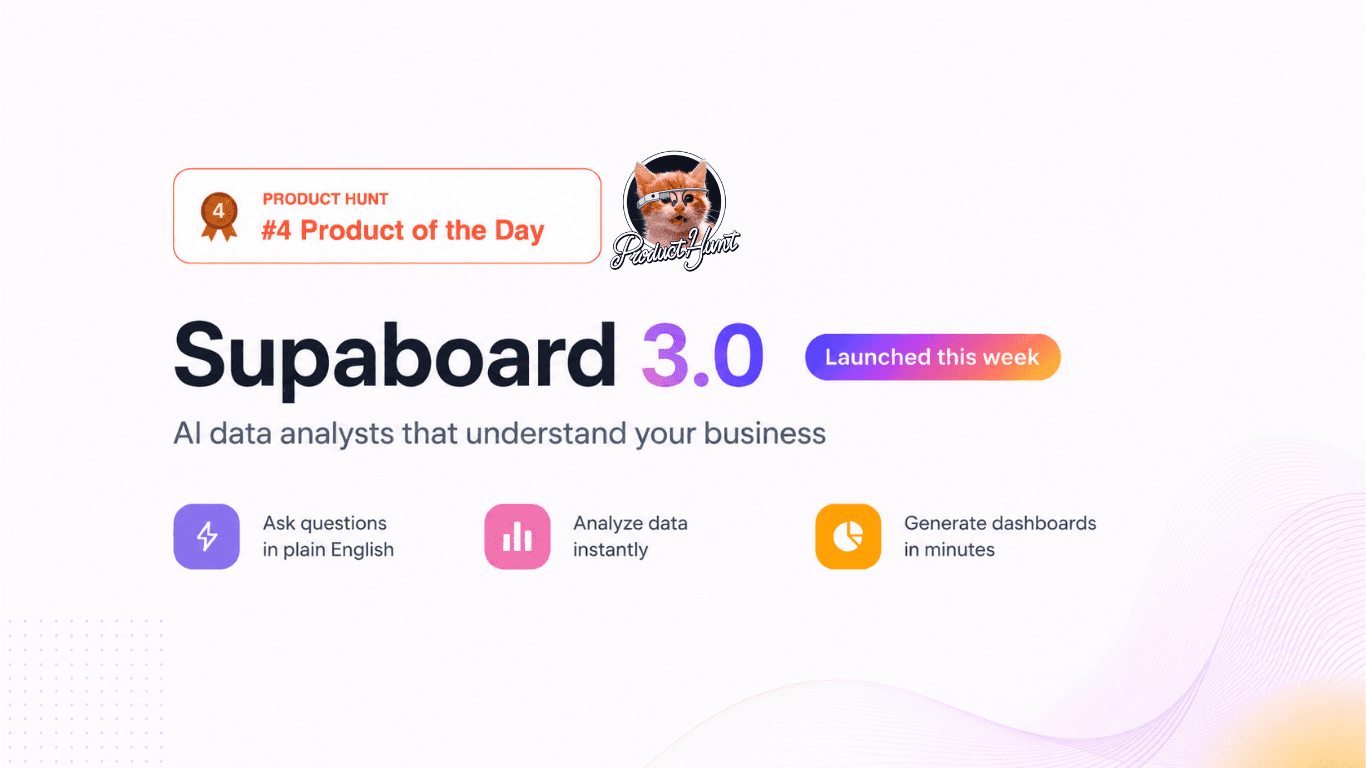
We recently launched Supaboard AI 3.0 on Product Hunt, and one thing became clear from the conversations we had there: teams everywhere are frustrated with how hard it still is to get answers from their data.
Despite having more dashboards and tools than ever, simple questions often still require SQL, spreadsheets, or waiting on someone else to pull a report.
That’s why we built Supaboard.
Supaboard helps teams ask questions in plain English, explore data conversationally, and build dashboards in seconds.
With Supaboard 3.0, we’ve made the platform faster, smarter, and more powerful than ever.
In this article, we’ll share what’s new, how teams are using it, and what we learned from our Product Hunt launch.
The Big Problem with Traditional Business Intelligence Tools
Today, businesses collect data from dozens of sources. CRM platforms are used by sales teams, marketing launches campaigns on different channels and operations keeps an eye on inventory in different systems. The result is data everywhere.
A lot of companies use tools like Metabase, Looker or Power BI. While these solutions work well for the technical user, they often leave non-technical team members waiting for reports. Business users struggle to get answers quickly and analysts spend hours writing queries.Common complaints include:
SQL is too time consuming
Dashboard overload that gets old fast
Trouble consolidating data from various tools
Ad-hoc questions lead to slower response times
We built Supaboard AI to solve these very problems. It lets anyone on the team ask questions in plain English and get back accurate, contextually relevant insights, without needing to write any code.
Introducing Supaboard AI: AI-Native Business Intelligence
Supaboard AI is an intelligent platform designed for the entire team. It combines natural language processing with deep business logic understanding. Unlike basic text-to-SQL tools that often miss context, Supaboard uses specialized agents that learn your company specific metrics, definitions, and workflows.
Key benefits include:
Instant answers from multiple data sources
Automatic dashboard creation
Full transparency for technical users
Strong security and governance features
Since our initial launch, we have focused on continuous improvement based on user feedback. This dedication led to the release of version 3.0.
What is New in Supaboard AI 3.0
Supaboard represents a major upgrade. We listened to over 1000 teams and implemented changes that make the platform faster, smarter, and more complete.
Here are the standout improvements:
Redesigned user interface with smoother navigation and analytics workflows. The new design reduces clicks and makes daily use more enjoyable.
Much faster performance and response times. Complex queries that once took minutes now deliver results in seconds.
Enhanced accuracy through business-logic-aware agents. The AI now understands fiscal calendars, custom KPIs, and department-specific definitions.
Expanded connectivity with over 700+ data connectors. This covers popular databases, SaaS applications, and business tools.
MCP support and built-in tools that enable more flexible AI agent workflows.
Stronger enterprise features including role-based access control, detailed audit trails, and advanced security measures.
These updates have transformed Supaboard AI into a full AI-native business intelligence platform that serves both technical and non-technical users effectively.
Real World Use Cases and Team Success Stories
More than 1000+ teams now use Supaboard AI regularly. They have created thousands of dashboards that help drive faster decisions.
In sales and marketing departments, teams connect multiple sources to track campaign performance and pipeline health in real time. E-commerce businesses use it to monitor inventory and operations across logistics partners. Healthcare organizations appreciate how it unifies patient and operational data without complex setup.
One popular pattern is conversational analysis. Users start with one question, follow up with related ones, and discover insights they did not initially expect. Several teams even generate complete PowerPoint presentations directly from Supaboard for stakeholder meetings.
For non-technical teams, this means reduced dependency on data engineers. Business users can explore data independently while analysts retain full control through visible queries and drill-down capabilities.
What Users Are Saying About Supaboard AI
Feedback from the community has been very positive. Here are some real examples:
Peter Claridge highlighted the challenge of managing multiple dashboards and Excel sheets. He asked about the biggest use cases. Our response focused on teams combining data from various sources for sales, marketing, and weekly reporting. The most exciting part is watching users treat the platform like a conversation with their data.
Olivier Jury asked whether a team of 10 non-technical people should replace Metabase or Looker completely. We explained that with proper upfront setup of business context, Supaboard can serve as the primary workspace. Otherwise, it works excellently as a complement for quick queries.
Shivam Jaiswal wanted to know how the platform handles shifting metrics mid-cycle. We shared that change is built into the design. The AI expects metrics to evolve and adapts without requiring constant retraining.
Samir Asadov, who works with financial models, emphasized the need for auditability. Supaboard delivers full traceability. Every number links back to source queries and rows. The same question on unchanged data always returns consistent results.
Thami Benjelloun asked if analysts can review generated queries. The answer is yes. Supaboard displays queries clearly so technical users can verify and modify them when needed.
Dmitry Isaevski mentioned the pain of reconciling data between disconnected tools. We now support over 600 connectors and continue to add more based on user requests.
Check out all the feedback on our Product Hunt launch page.
These conversations show that Supaboard AI addresses genuine pain points in business intelligence.
Our Product Hunt Launch Experience and Lessons Learned
To reach more teams struggling with data challenges, we decided to launch Supaboard AI 3.0 on Product Hunt. Product Hunt is a popular platform where new products get discovered by early adopters, founders, and technology enthusiasts.
Many people search for Product Hunt upvote strategies, how to get featured on Product Hunt, or Product Hunt launch tips when preparing their own launches. Our experience taught us several practical lessons.
We offered genuine updates based on actual customer feedback and concentrated on communicating clearly about the issue we resolved. The community gave a powerful response. The #4 Product of the Day was Supaboard AI 3.0. Sincere upvotes and insightful remarks from analysts, founders, and BI professionals led to this rating.
What we already knew was confirmed by the conversations on Product Hunt. Teams seek tools that minimize reliance on SQL, offer quick solutions, and uphold openness. The product's ascent in the rankings confirmed months of concentrated development.
The secret is straightforward whether you're looking for Product Hunt success stories or Product Hunt upvote tricks: create something that genuinely resolves a difficult issue and interact openly with the community.
Why Supaboard AI Stands Out in the AI Business Intelligence Space
Supaboard differs from generic AI analytics tools in important ways. Many solutions offer basic text-to-SQL but fail when business logic conflicts arise. Supaboard treats business context as a first-class citizen.
The platform handles live data changes gracefully. It supports governance requirements that enterprise teams need. Most importantly, it empowers non-technical users while giving power users full visibility.
Compared to traditional BI tools, Supaboard reduces reporting cycles dramatically. Teams report saving hours every week that were previously spent on manual reconciliation and dashboard maintenance.
Getting Started with Supaboard AI
Trying Supaboard AI is straightforward. You can sign up for free. Connect your data sources, define key business logic once, and start exploring.
Whether you manage a small team or work in a larger organization, the platform scales with your needs. Free users can test core features while paid plans unlock advanced connectors and governance tools.
We actively encourage feedback. Teams working with analytics, dashboards, reporting, or AI workflows can share their experience directly with us.
Final Thoughts on the Future of Business Intelligence
The launch of Supaboard AI 3.0 and our Product Hunt success mark an important milestone. But we are still early in our mission to make data accessible to everyone.
As AI capabilities continue to advance, the winners will be platforms that combine intelligence with usability, transparency, and trust. Supaboard AI aims to lead in this space.
If your team struggles with data silos, slow reporting, or SQL bottlenecks, we invite you to explore Supaboard AI 3.0.
Ready to transform how your team uses data?
Visit the Product Hunt page to learn more and start your free trial: Try Supaboard AI for Free
Book a demo or reach out with your specific use case. We read every message and use feedback to shape future updates.
Thank you for reading this detailed Supaboard AI 3.0 review. We look forward to helping more teams make better decisions with data.