data · · Updated · 8 Min Read
Positive vs Negative Correlation, With Examples
Positive correlation means variables move together, negative means apart. How to read strength and direction, and how to avoid the dual-axis trap.

Deepak Singh
Introduction
The world of statistics and investment strategies is a complex one, which requires a clear understanding of correlation dynamics. Fundamentally correlation is a measure of a relationship between two variables in a given environment. This concept is quite applicable in many areas, especially in statistics and finance. People often need to predict what is going to happen next, to decide how to invest money, and to learn about the behaviour of markets. There are 2 types of correlation: positive and inverse (or negative) correlations . Each kind of correlation is a different type of relationship between variables.
What Is Correlation?
Correlation is a statistical measure that describes the association between two distinct variables. It shows whether the variables have a tendency to move together and, if so, in which direction, either the same direction or opposite directions. In simple terms, correlation is a powerful tool that helps us study and understand the relationship between two variables. It is widely used to analyze patterns in data and provides valuable insights into economic, business, and real-world behavior.
For example, you may find that the more hours a person studies, the higher his or her test scores tend to be. Or the higher the price of a product , the less units are usually sold . Correlation picks up on such patterns, without saying that one thing causes the other.
Important point to note: Correlation does not imply causation. Two things can be related, even if something else is driving them both.
Understanding the Correlation Coefficient
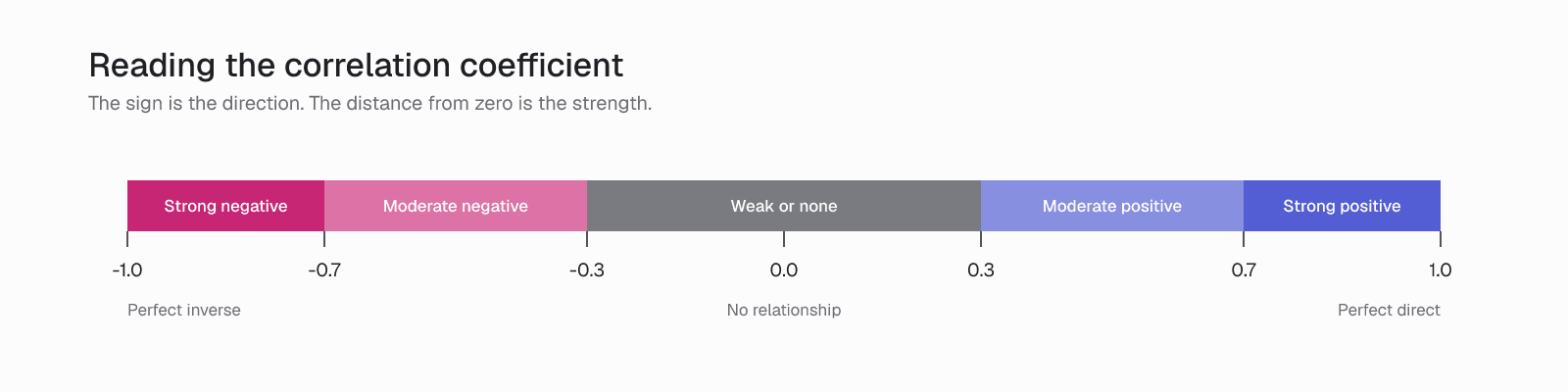
The strength and direction of a correlation are measured by a number called the correlation coefficient (denoted as r). This value always ranges between -1 and +1.
-
A value near +1 indicates a strong positive correlation.
-
A value near 0 indicates little or no linear relationship.
-
A value near -1 indicates a strong negative (inverse) correlation.
Correlation Coefficient Interpretation Table
| Value of r | Interpretation | What it looks like in business data |
|---|---|---|
| +0.7 to +1.0 | Strong positive | Ad spend and revenue in a channel that scales predictably |
| +0.4 to +0.69 | Moderate positive | Email send volume and signups — real, but other factors dominate |
| +0.1 to +0.39 | Weak positive | Website visits and purchases across a broad, mixed audience |
| 0 | No linear relationship | Support ticket volume and headcount, once you control for season |
| −0.1 to −0.39 | Weak negative | Page load time and conversion on a fast site already |
| −0.4 to −0.69 | Moderate negative | Discount depth and margin across a varied product catalogue |
| −0.7 to −1.0 | Strong negative | Churn rate and NPS — as satisfaction falls, churn climbs |
Two cautions before you act on any of these. The coefficient measures linear relationships only, so a strong curved relationship can still show an r near zero. And a high coefficient is not causation: ice cream sales and drowning deaths correlate strongly, and neither causes the other — summer causes both.
The positive or negative sign tells the direction of the relationship, while the number’s distance from zero shows how strong it is.
Positive Correlation: When Variables Move in the Same Direction
In a positive correlation, both variables move together. As one increases, the other also tends to increase. When one decreases, the other also tends to decrease.
Here are four strong real-world examples:
-
Students who spend more time studying consistently achieve higher exam scores.
-
Companies that invest more in advertising generally see higher product sales and revenue.
-
Employees with more years of professional experience typically earn higher salaries.
-
Patients who attend more regular physiotherapy sessions tend to experience faster recovery rates.
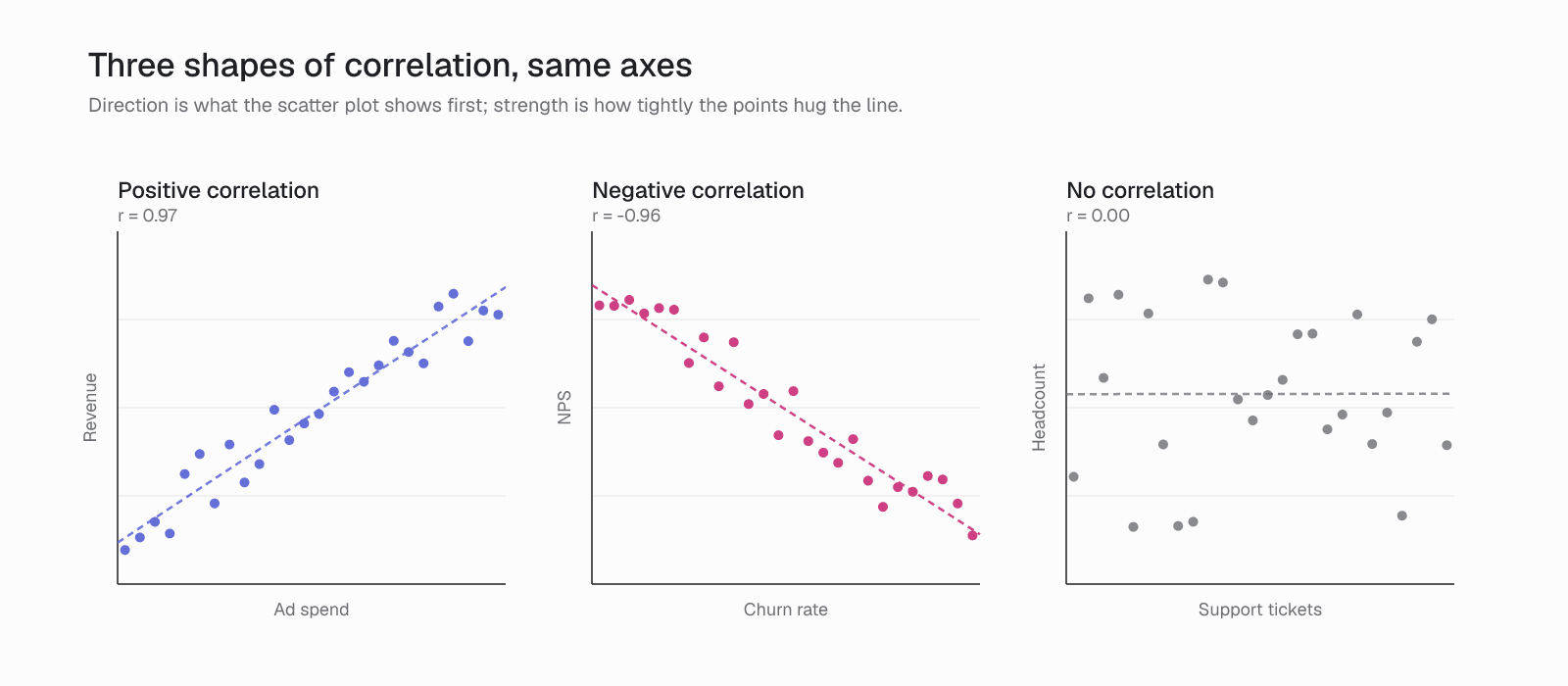
On a scatter plot, positive correlations appear as an upward-sloping pattern, with dots rising from left to right.
Negative Correlation (Inverse Correlation): When Variables Move in Opposite Directions
A negative correlation, also known as inverse correlation or an inverse relationship, occurs when two variables move in opposite directions. As one increases, the other tends to decrease.
Here are four strong real-world examples:
-
When the price of a product increases, the quantity demanded by customers usually decreases.
-
Individuals who exercise more regularly and intensely often maintain lower body fat percentages.
-
As interest rates rise, the demand for new home loans and mortgages typically falls.
-
Higher levels of daily work stress are frequently linked with reduced quality of sleep and overall well-being.
On a scatter plot, negative correlations show a downward-sloping pattern.
Positive vs Negative Correlation: Side-by-Side Comparison
| Aspect | Positive Correlation | Negative (Inverse) Correlation |
| Direction of Movement | Both variables move together | Variables move in opposite directions |
| Coefficient Sign | Positive (+) | Negative (-) |
| Graph Pattern | Upward slope | Downward slope |
| Everyday Example | More study time → Higher marks | Higher price → Lower demand |
| Practical Meaning | Variables reinforce each other | One variable counters the other |
The opposite of an inverse relationship (negative correlation) is a positive or direct relationship.
How to Visualize Correlation Effectively
Visualization is one of the best ways to understand correlation. Always start by creating a scatter plot in tools like Excel, Google Sheets, or any data software.
Look at the overall pattern of the dots:
-
Upward trend → Positive correlation
-
Downward trend → Negative (inverse) correlation
-
No clear pattern → Near zero correlation
A tight grouping of dots around a straight line indicates a stronger relationship. Loose, scattered dots suggest a weaker one. Sometimes the pattern may be curved, showing that a simple linear correlation does not fully capture the relationship.
Common Confusions and Mistakes to Avoid
Several misunderstandings frequently appear when people learn about correlation:
-
Assuming that correlation proves one thing causes another (the ice cream sales and shark attacks example — both rise in summer due to hot weather).
-
Thinking zero correlation means there is absolutely no relationship (there could be a non-linear connection).
-
Allowing a few extreme outlier values to heavily influence the result.
-
Using the term “indirect correlation” loosely instead of the clearer terms “negative correlation” or “inverse correlation.”
Being aware of these helps in correctly interpreting data from studies, reports, or personal observations.
How to Calculate Correlation in Practice
Calculating correlation is straightforward with modern tools.
In Excel or Google Sheets:
-
Enter one variable’s data in Column A and the second variable in Column B.
-
In an empty cell, enter the formula: =CORREL(A2:A100, B2:B100)
-
The result gives the correlation coefficient instantly.
You can also insert a scatter chart and add a trendline to see the direction and strength visually. These simple methods work well for students, business analysts, and anyone working with data.
Practical Applications in Daily Life and Work
Understanding positive and negative correlation has wide-ranging uses:
-
Students can track study hours against exam performance to improve results.
-
Business teams analyze advertising spend versus revenue or product price versus sales volume.
-
Fitness enthusiasts monitor exercise duration against weight changes or body measurements.
-
Parents observe screen time versus children’s academic outcomes.
-
Investors study relationships between economic factors like interest rates and stock prices.
-
Researchers across fields use correlation to explore connections before designing more advanced experiments.
The most effective approach is to gather sufficient data, create visualizations, consider other influencing factors, and treat correlation as a starting point for further investigation.
Frequently Asked Questions
What is positive correlation?
Positive correlation means two variables tend to move in the same direction: as one increases, the other increases as well. Advertising spend and impressions usually correlate positively. The relationship describes co-movement only; it says nothing about whether one variable causes the other or whether a third factor drives both.
What is negative correlation?
Negative correlation means two variables move in opposite directions: as one rises, the other falls. Price and units sold frequently correlate negatively. As with positive correlation, the direction is a description of how the two series move together, not evidence that changing one will change the other.
What is the difference between correlation strength and direction?
Direction is whether the relationship is positive or negative. Strength is how tightly the points follow that pattern, usually expressed as a coefficient between minus one and one. Two relationships can share a direction while differing completely in reliability, and conflating the two is the most common reading error.
Does correlation imply causation?
No, and the distinction matters commercially. Two variables can correlate because one causes the other, because both respond to a third factor, or by coincidence in a small sample. Acting on a correlation without establishing a mechanism is how budgets get moved toward channels that were never responsible for the outcome.
How do I visualise a correlation properly?
Use a scatter plot with both variables on their own axes, which lets a reader see the spread as well as the trend. Avoid dual-axis line charts: by choosing the scales you can manufacture an apparent relationship between almost any two series. A real correlation survives being plotted separately.
What sample size do I need before trusting a correlation?
There is no single threshold, but small samples produce spurious correlations easily, and the fewer points you have the stronger an apparent relationship must be before it means anything. Check whether the pattern holds when you split the data by segment or period; genuine relationships usually survive that test.
Conclusion
A positive correlation means that both variables move in the same direction . For example , study time and academic performance , or temperature and ice cream sales . Negative correlation, or inverse correlation, is when two things go in opposite directions. Price and demand, or exercise and body fat, are examples.
Understanding the difference between positive and negative correlation will help you interpret data more effectively, make better choices, and avoid common mistakes in school, work, health, finance, and daily life. These concepts are simple and useful to anyone working with information or trying to make sense of patterns around them with clear examples and practical tools.
This knowledge is a strong foundation for more advanced data analysis and critical thinking in a world of numbers and relationships.
Spotting a correlation is the easy half; the work is checking whether it holds once you control for the obvious confounder, and that means running the follow-up query rather than reading a chart. An AI data analyst will do that follow-up for you — Supaboard's Ask Analysts answers the question and shows the SQL behind it, at a flat per-seat price so exploring costs nothing extra.

 32 Min Read