


Intro: why “Supaboard vs Superset” is a common search
Choosing a BI tool in 2026 isn’t just about charts, it’s about speed, usability, and who actually gets insights.
That’s why “Supaboard vs Apache Superset” has become a common search for founders, product leaders, and data teams evaluating modern analytics stacks.
Apache Superset is a powerful open-source platform built for SQL-first teams that want full control. Supaboard represents the new wave of AI-powered BI, where dashboards are generated through natural-language prompts and insights arrive in minutes, not weeks.
This comparison isn’t about "which tool is better,” but which one fits how your team works today. In this guide, we break down Supaboard vs Apache Superset across setup time, usability, embedded analytics, and real-world outcomes, so you can confidently choose the right BI tool for 2026.
What Is Apache Superset and What Does It Do Well?
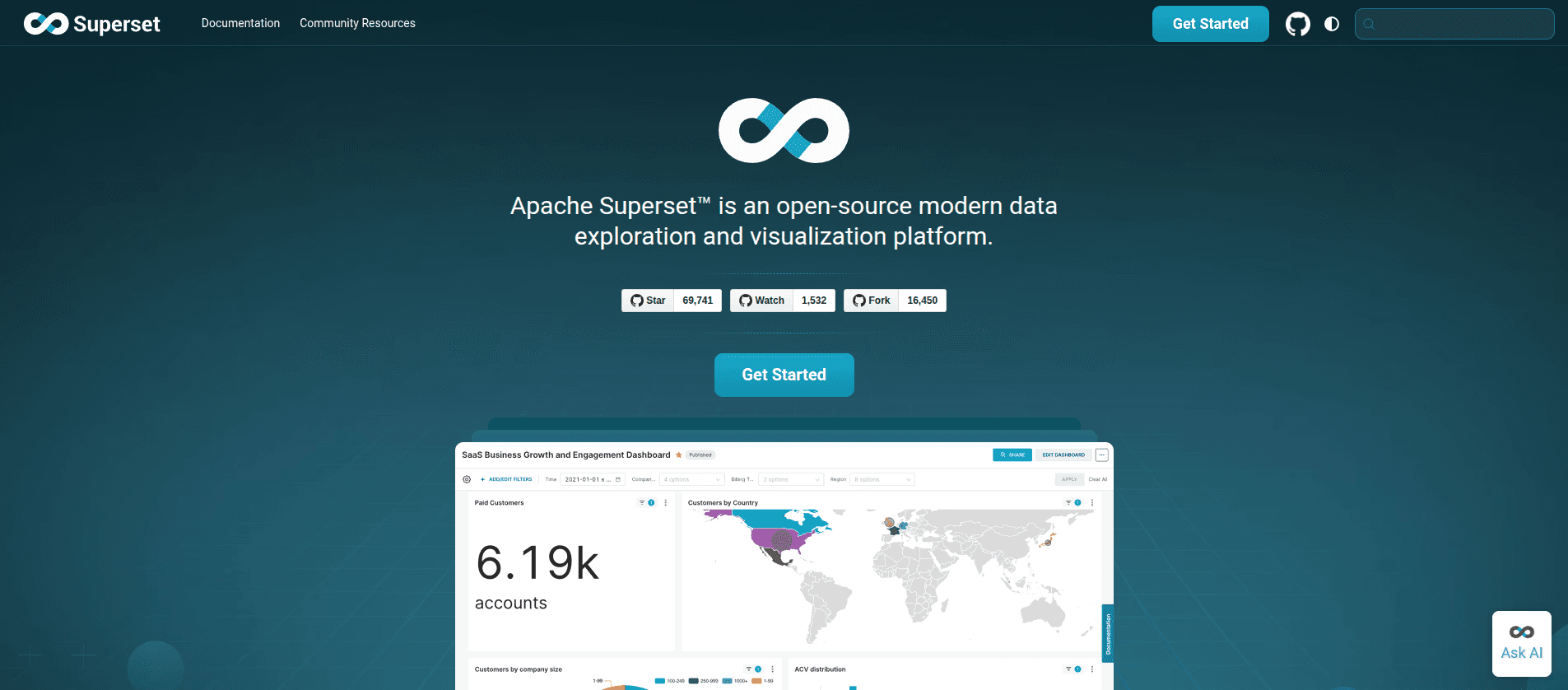
Apache Superset is an open-source, enterprise-ready data exploration and visualization platform originally developed at Airbnb to support large-scale analytics. It connects directly to SQL-based databases and allows teams to create interactive dashboards, charts, and reports without relying on proprietary BI software.
Superset is designed to serve both technical and semi-technical users. It combines no-code chart creation with a powerful web-based SQL editor called SQL Lab, making it especially attractive to analytics engineers and SQL-savvy analysts.
What Apache Superset Does Well
Offers more than 40 visualization types, including advanced geospatial charts
Enables interactive dashboards with filters, drill-downs, and templating
Supports a wide range of SQL and cloud-native data sources
Includes a lightweight caching layer to improve query performance
Provides extensible security roles and authentication options
Scales well with cloud-native and big-data architectures
Apache Superset works best for teams that want full control over their BI environment and are comfortable managing SQL, infrastructure, and data modeling.
What User say:

What Is Supaboard and What’s Different About It?
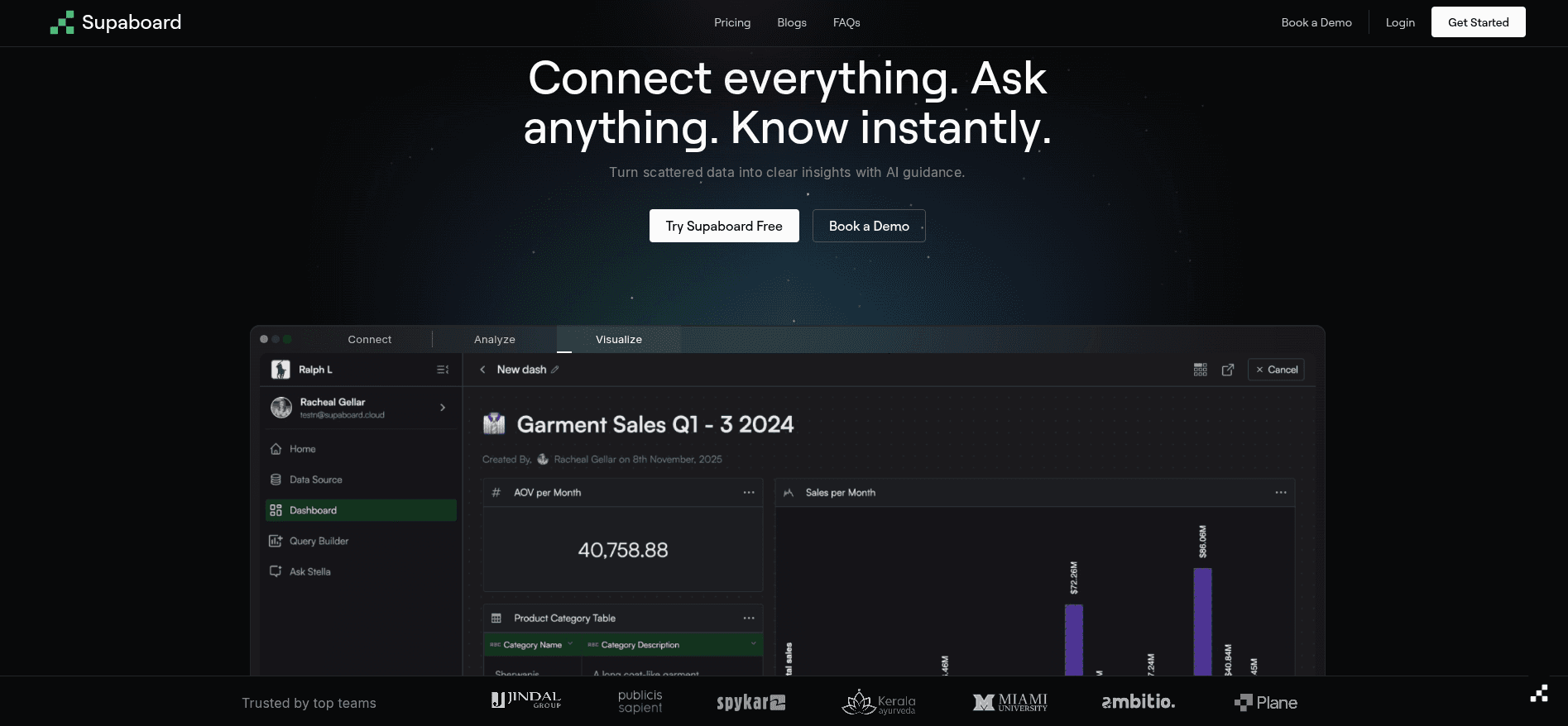
Supaboard is an AI-first business intelligence platform built for fast-growing startups, SaaS companies, and modern enterprises that want answers without complexity. Instead of relying on SQL queries or manual dashboard configuration, Supaboard allows users to create dashboards using plain-English prompts, acting like a virtual analyst for the business.
Supaboard unifies data from hundreds of tools into a single, real-time view, helping teams move from scattered reports to actionable insights in minutes. While traditional BI tools are built primarily for analysts, Supaboard is designed for founders, product managers, and business teams who want insights without technical barriers.
What Supaboard Does Well
Generates dashboards, KPIs, and charts from natural-language prompts
Requires no SQL or BI training
Offers 600+ one-click data integrations
Treats embedded analytics as a first-class feature
Delivers significantly faster time-to-value for product and growth teams
Supaboard is ideal for teams that want insights immediately, not after weeks of setup or data modeling.
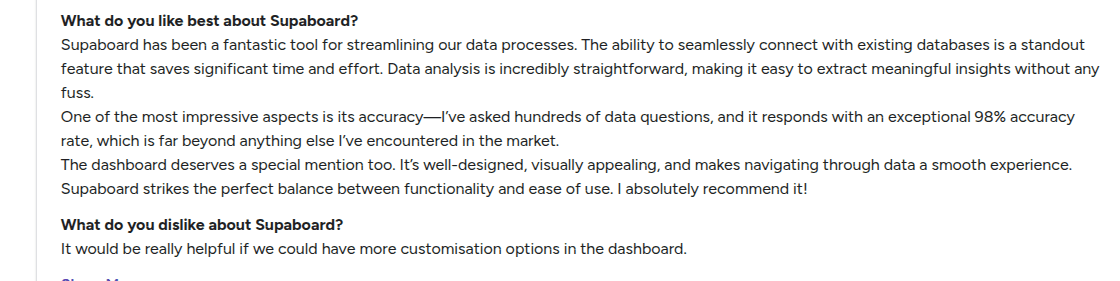
What User say:
Real-World Example: Measurable Impact from Automated Analytics
A US-based healthcare revenue cycle management company relied on manual spreadsheet reporting for claims, billing, A/R, and denial data, slowing decisions and increasing costs.
After implementing Supaboard, the results were immediate:
Daily analysis time dropped from ~4 hours to 2-3 minutes
Analytics labor costs reduced to roughly one-tenth of prior levels
Faster detection of revenue leakages, credit issues, and bottlenecks
Teams moved from reactive reporting to proactive, insight-driven operations
Supaboard vs Apache Superset: Head-to-Head Comparison
Setup and Time-to-Value
Apache Superset is self-hosted and highly configurable, but setup typically involves managing deployments, user permissions, datasets, and governance. Organizations often need dedicated data or DevOps teams before dashboards become fully operational.
Supaboard reduces setup effort through prompt-based workflows and pre-built integrations. Teams can generate their first dashboards quickly, trading some manual control for faster onboarding and reduced operational overhead.
User Experience: Self-Serve vs SQL-First
Superset follows a SQL-first approach. Analysts and engineers can write queries, define metrics, and build dashboards, but business users may face a learning curve. Advanced customization is possible, though it often requires data modeling expertise.
Supaboard relies on natural-language input, allowing non-technical users to generate charts and KPIs without writing SQL. This makes adoption easier across teams, though highly complex or custom analyses may be less controllable than hand-written SQL.
Modeling and Semantic Layer
Superset provides a thin semantic layer for metrics and calculated columns, offering some consistency across dashboards. However, deeper governance and modeling still depend heavily on SQL and external processes.
Supaboard abstracts much of the modeling process by automatically translating questions into visualizations. Governance is handled through access controls and workflow conventions, but users have less direct control over underlying calculations.
Embedded Analytics and Sharing
Supaboard allows dashboards to be embedded via links or iframes for both internal and customer-facing use cases. Embedding is handled directly within the platform, making it well-suited for SaaS products and client portals.
Superset can also support embedding, but it typically requires additional configuration around authentication, security, and infrastructure. As a result, it is more commonly used for internal dashboards.
Customization, Extensibility, and Cost Model
Apache Superset is open-source and self-hosted, enabling extensive customization and extensibility. However, teams are responsible for hosting, maintenance, upgrades, and scaling.
Supaboard is a managed platform with built-in automation. Teams trade some flexibility for predictable costs, lower operational burden, and faster iteration cycles.
Supaboard vs Apache Superset: Quick Comparison
Feature | Supaboard | Apache Superset |
|---|---|---|
Tool type | AI-powered BI platform | Open-source BI tool |
Primary approach | Natural-language, prompt-based analytics | SQL-first dashboarding |
Target users | Founders, product & business teams | Analysts, engineers, BI teams |
Technical skills required | None or minimal | Strong SQL & data modeling |
Setup & deployment | Fully managed | Self-hosted |
Time to first dashboard | Minutes | Hours to days |
Dashboard creation | AI-generated | Manual |
Semantic layer | Abstracted, AI-managed | Thin, SQL-driven |
Embedded analytics | First-class feature | Requires extra configuration |
Customization | Medium | High |
Maintenance | Platform-managed | Managed internally |
Cost model | Subscription-based | Free software + infra costs |
Best suited for | Fast insights, embedded analytics | Internal BI, full control |
When to Choose Which BI Tool
Choose Apache Superset If:
You need full control over hosting, customization, and extensions
Your team has SQL-capable analysts or engineers
You prioritize internal dashboards and detailed data modeling
Website Link: https://superset.apache.org/
Choose Supaboard If:
You want faster dashboard creation with minimal setup
Your team includes non-technical users who need self-service analytics
You plan to embed dashboards into products or client-facing applications
Website Link: https://supaboard.ai/
In short, Superset emphasizes flexibility and control, while Supaboard emphasizes speed, accessibility, and ease of use.
Frequently Asked Questions(FAQs)
Is Apache Superset better than Supaboard for large enterprises?
Apache Superset is commonly used by organizations that need full control over infrastructure, governance, and SQL-based customization. Supaboard is often considered by teams looking for faster deployment, AI-assisted analytics, and reduced operational complexity. The right choice depends on factors such as team skill sets, governance requirements, and how quickly insights are needed across the organization.
Can non-technical users use Apache Superset effectively?
Apache Superset includes no-code chart builders, but most advanced usage still depends on SQL knowledge and data modeling. Non-technical users often rely on analysts to prepare datasets, whereas Supaboard enables non-technical users to ask questions and generate dashboards directly using natural language.
Does Supaboard replace the need for data analysts?
Supaboard does not eliminate the need for data analysts, but it significantly reduces manual reporting and dashboard creation. Analysts can focus more on deeper analysis and strategy, while business users independently access routine insights through AI-generated dashboards.
What databases does Apache Superset support?
Apache Superset supports a wide range of SQL-compatible databases, including PostgreSQL, MySQL, Snowflake, BigQuery, Redshift, and many others. Its flexibility makes it popular among data teams working with diverse data infrastructures.
Which tool is better for embedded analytics in SaaS products?
Supaboard is generally better suited for embedded analytics due to its built-in embedding features, access controls, and product-friendly workflows. Apache Superset can be embedded, but typically requires additional engineering effort for authentication and security.
Conclusion
Apache Superset offers open-source flexibility and full control for SQL-first teams, while Supaboard prioritizes AI-driven insights, fast onboarding, and embedded analytics for business users. The right choice depends on your team’s technical capabilities, governance needs, and how quickly you need actionable insights.
If speed and AI-powered analytics matter more than manual setup and SQL control, Supaboard may be worth exploring.