
Objection.ai

How Objection.ai runs a no-data-analyst company with Supaboard
What we did
11 sources
Product DB, ads suite, Asana, Cloudflare, PostHog, Stripe & Twilio — unified
0 analysts
The company runs without a data analyst on board
2 teams
Marketing & product, fully self-serve on one source of truth
"When asking the data a question is free and instant, every meeting brings receipts. Decisions get made with evidence by default."
11 systems — product DB · LinkedIn / X / Instagram / Google Ads · Asana · Cloudflare · PostHog · Stripe · Twilio
Zero analysts — marketing & product run self-serve
Objection.ai built a modern stack the way modern companies do: their product database, the full ads suite (LinkedIn, X, Instagram, Google), Asana for execution, Cloudflare for infrastructure, PostHog for product analytics, Stripe for revenue, and Twilio for communications. Eleven systems, each holding a piece of the truth.
The conventional next step is to hire a data analyst, then a second, then build a warehouse, then hire a third. Objection.ai went the other direction — they decided to run the company without a data analyst at all, with Supaboard as their data headquarters.
Eleven systems, and a choice not to hire analysts
Every modern company hits the same fork: the stack sprawls, the questions multiply, and the default answer is to hire. Objection.ai chose differently:
A sprawling, modern stack: Product DB, four ad platforms, Asana, Cloudflare, PostHog, Stripe, and Twilio — eleven systems in all.
Each holding a piece of the truth: No single tool could answer a question that spanned marketing, product, and revenue.
The conventional path: Hire an analyst, hire a second, build a warehouse, hire a third — cost, hiring cycles, and a new bottleneck.
The other direction: Run the company self-serve, with Supaboard as the data headquarters instead of a data team.
One data headquarters for eleven sources
Supaboard became Objection.ai's data headquarters. Every source unified into one place, and the trainable agent learned how the company thinks about its funnel, its campaigns, and its operating cadence:
All eleven sources, one place: From the product database through the ads suite, Asana, Cloudflare, PostHog, Stripe, and Twilio.
Trained on the business: The agent learned Objection.ai's funnel, campaign structure, and operating cadence.
Analyst questions, no analyst: The questions that would normally route through an analyst route through the agent instead.
Marketing: four-platform attribution in one query
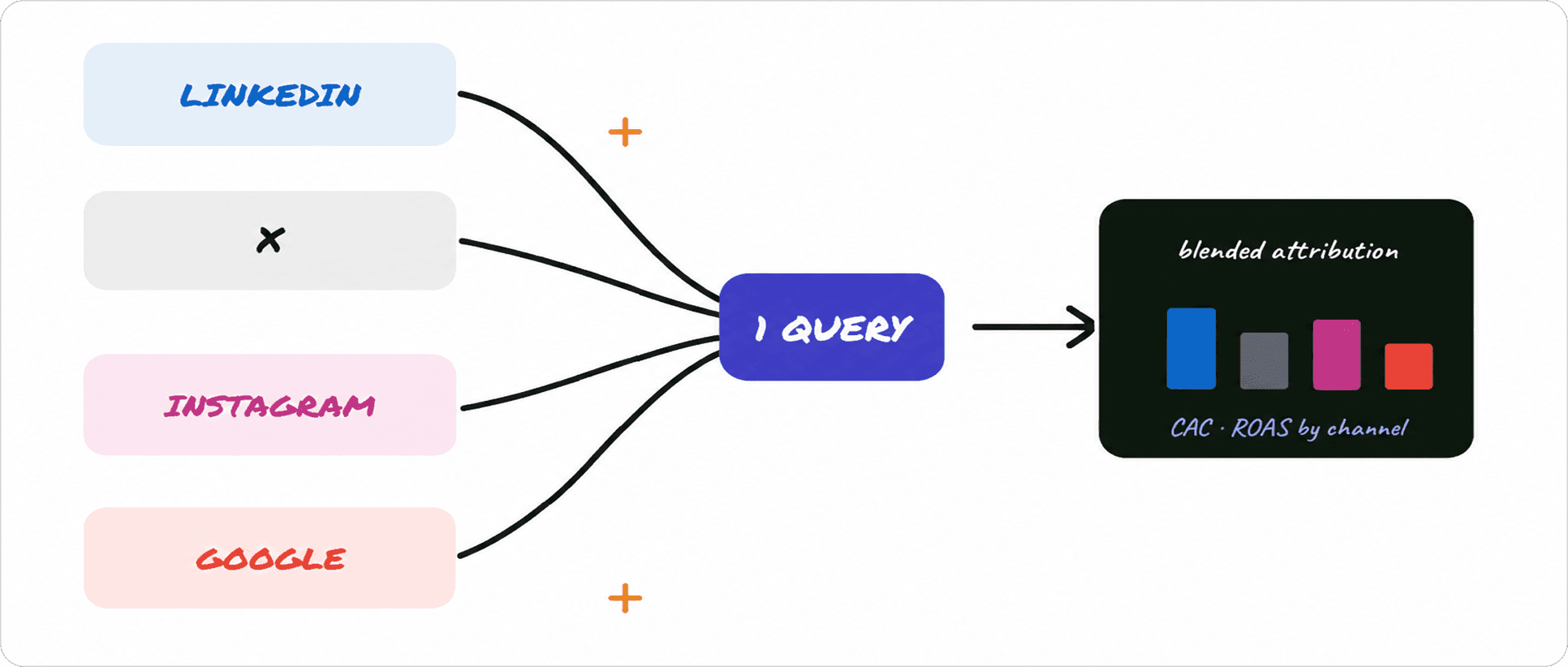
Marketing pulls campaign attribution across four ad platforms — LinkedIn, X, Instagram, and Google — in a single query. No exports, no stitching, no analyst in the loop.
Blended performance across every channel, answered the moment the question is asked.
Product: PostHog behavior joined to Stripe revenue
Product pulls behavioral data from PostHog joined against revenue from Stripe — connecting what users do to what they pay, in a single question.
The join that used to need an analyst and a warehouse now happens in a sentence.
Supaboard's impact on Objection.ai
Objection.ai runs the entire business on Supaboard. Marketing and product teams operate self-serve against eleven integrated sources:
Zero data analysts: The company runs without the cost, hiring cycle, or bottleneck of a data team.
Self-serve across eleven sources: Marketing and product answer their own questions, end to end.
Evidence by default: When asking the data a question is free and instant, every meeting brings receipts.
Marketing campaigns, product experiments, finance reviews, operations cadence: all of it runs on one source of truth.